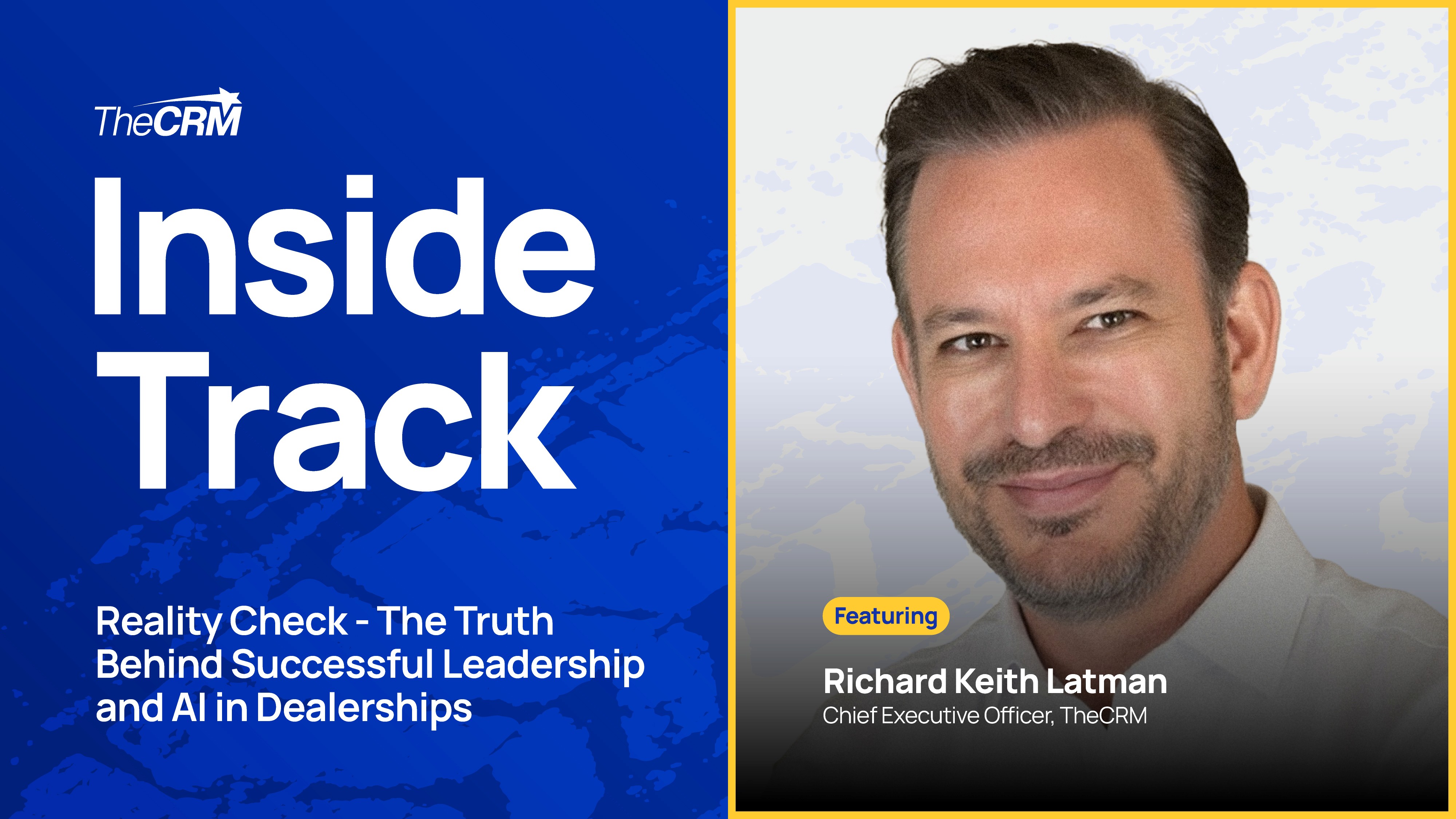
Inside Track: Reality Check - The Truth Behind Successful Leadership and AI
in Dealerships
By TheCRM
February 3, 2026
————————————————————
In this edition of Inside Track, we sat down with TheCRM’s founder and CEO to talk candidly about leadership lessons learned the hard way, why accountability is the real fear around AI, and what most dealerships get wrong long before data or process ever enter the conversation.
What followed was an unfiltered conversation shaped by decades in technology, hard-earned failures, and a clear-eyed view of where automotive retail
is headed next.
What’s a lesson you learned early in your career that still shapes how you lead today?
Richard:
Early in my career, I failed. Big time. In
1999, I was part of a dot-com company
that collapsed and wiped out over a billion dollars in value. You learn a lot when
that happens.
The biggest lesson was this: no matter
how good you think you are, you can’t run
a company by yourself. This isn’t baseball where it’s all on one person in the ninth inning. It’s football. Everyone has an assignment, especially late in the game,
and success depends on execution across the entire team.
Has your thinking about technology changed as it’s evolved?
Richard:
I’ve always been forward-thinking. I actually invented one of the first internet appliances, that was the company that failed.
But I don’t believe evolution or learning should ever stop. The moment it does, you’re done. I still feel like I’m 35 years old because I’m always learning. The best student wins.
When you walk into an underperforming dealership, what’s the first signal you notice?
Richard:
That one’s easy. When salespeople are running the dealership day-to-day, it never performs well.
Even the best player needs to be coachable. When managers are inactive, when oversized personalities aren’t being guided or challenged, you don’t win. Salespeople have to be able to take feedback, accept criticism, and adjust. When they don’t and when managers let salespeople choose how things run, it never works.
What is the industry really afraid of when it comes to AI?
Richard:
Accountability.
For the last 30 years, dealerships have
never used their CRM anywhere close to full capacity. Maybe five or ten percent. And when performance slips, people look for reasons not to be accountable.
AI changes that. It doesn’t miss calls. It doesn’t forget follow-ups. It exposes gaps
in management, sales behavior, customer engagement, and that makes people uncomfortable.
AI isn’t replacing salespeople. It’s not doing walk-arounds or building human trust. But it is doing what salespeople don’t consistently do well: maintaining a pipeline, following up, and keeping momentum.
Sales has traditionally been feast or famine. One great month followed by starting at zero again. AI stabilizes that cycle. It keeps the pipeline moving.
Are dealerships really worried about salespeople being replaced?
Richard:
No. That’s not the real fear.
Salespeople are there to sell and deliver cars. If you have four deliveries on a Saturday, you physically can’t also handle follow-up calls and outreach. Yet when those calls don’t happen, everyone
points fingers.
AI closes those gaps. It supports salespeople instead of overloading them. Their job shouldn’t be making hundreds of calls, it should be closing deals and delivering cars.
How do you think about trust when it comes to AI?
Richard:
It’s a misconception to think AI has to “earn” a seat at the table.
It already performs better than the average salesperson in key areas. It closes gaps on missed calls, missed appointments, and missed opportunities. It often facilitates better customer relationships than inconsistent human follow-up.
This isn’t an attack on salespeople, it’s reality. The question isn’t whether AI can help. It already does.
Can traditional dealerships really compete with tech-forward dealers like Tesla?
Richard:
Anyone who says consumers aren’t ready for AI is ignoring Tesla.
Tesla became the number one car company in the world without traditional sales interactions. You don’t talk to a human until pickup. These companies are highly technical, highly responsive, and efficient.
Our challenge at TheCRM is making sure the rest of the industry can keep pace and giving dealerships the tools to do that.
————————————————————
What does running a tech company teach you that no one prepares you for?
Richard:
Most successful tech companies are led
by technologists.
You can’t just hand a tech company to someone who’s never worked around technology. They won’t understand what’s possible or what isn’t. They’ll rely on secondhand explanations of “barriers” instead of firsthand knowledge.
Look at the most successful leaders in
tech. They understand the building blocks. That matters.
————————————————————
What’s an unpopular belief you hold about dealership marketing?
Richard:
A few, actually.
I think demo marketing is largely a scam. I don’t think Google Ads are nearly as effective as people believe. And I believe SEO and SEM will become far less valuable as AI dominates search.
That’s a massive industry tied to automotive marketing, and I don’t think people like hearing that. But I believe it’s true.
Stay Up-to-Date
with Inside Track
Inside Track: Reality Check - The Truth Behind Successful Leadership and AI in Dealerships
By TheCRM
February 3, 2026
———————————————————————————————————————————————————————————————
In this edition of Inside Track, we sat down with TheCRM’s founder and CEO to talk candidly about leadership lessons learned the
hard way, why accountability is the real fear around AI, and what most dealerships get wrong long before data or process ever enter
the conversation.
What followed was an unfiltered conversation shaped by decades in technology, hard-earned failures, and a clear-eyed view of where automotive retail is headed next.
What’s a lesson you learned early in your career that still shapes how you lead today?
Richard:
Early in my career, I failed. Big time. In 1999, I was part of a dot-com company that collapsed and wiped out over a billion dollars in value. You learn a lot when that happens.
The biggest lesson was this: no matter how good you think you are, you can’t run a company by yourself. This isn’t baseball where it’s all on one person in the ninth inning. It’s football. Everyone has an assignment, especially late in the game, and success depends on execution across the entire team.
Has your thinking about technology changed as it’s evolved?
Richard:
I’ve always been forward-thinking. I actually invented one of the first internet appliances, that was the company that failed.
But I don’t believe evolution or learning should ever stop. The moment it does, you’re done. I still feel like I’m 35 years old because I’m always learning. The best student wins.
When you walk into an underperforming dealership, what’s the first signal you notice?
Richard:
That one’s easy. When salespeople are running the dealership day-to-day, it never performs well.
Even the best player needs to be coachable. When managers are inactive, when oversized personalities aren’t being guided or challenged, you don’t win. Salespeople have to be able to take feedback, accept criticism, and adjust. When they don’t and when managers let salespeople choose how things run, it never works.
What is the industry really afraid of when it comes to AI?
Richard:
Accountability.
For the last 30 years, dealerships have never used their CRM anywhere close to full capacity. Maybe five or ten percent. And when performance slips, people look for reasons not to be accountable.
AI changes that. It doesn’t miss calls. It doesn’t forget follow-ups. It exposes gaps in management, sales behavior, customer engagement, and that makes people uncomfortable.
AI isn’t replacing salespeople. It’s not doing walk-arounds or building human trust. But it is doing what salespeople don’t consistently do well: maintaining a pipeline, following up, and keeping momentum.
Sales has traditionally been feast or famine. One great month followed by starting at zero again. AI stabilizes that cycle. It keeps the pipeline moving.
Are dealerships really worried about salespeople being replaced?
Richard:
No. That’s not the real fear.
Salespeople are there to sell and deliver cars. If you have four deliveries on a Saturday, you physically can’t also handle follow-up calls and outreach. Yet when those calls don’t happen, everyone points fingers.
AI closes those gaps. It supports salespeople instead of overloading them. Their job shouldn’t be making hundreds of calls, it should be closing deals and delivering cars.
How do you think about trust when it comes to AI?
Richard:
It’s a misconception to think AI has to “earn” a seat at the table.
It already performs better than the average salesperson in key areas. It closes gaps on missed calls, missed appointments, and missed opportunities. It often facilitates better customer relationships than inconsistent human follow-up.
This isn’t an attack on salespeople, it’s reality. The question isn’t whether AI can help. It already does.
Can traditional dealerships really compete with tech-forward dealers like Tesla?
Richard:
Anyone who says consumers aren’t ready for AI is ignoring Tesla.
Tesla became the number one car company in the world without traditional sales interactions. You don’t talk to a human until pickup. These companies are highly technical, highly responsive, and efficient.
Our challenge at TheCRM is making sure the rest of the industry can keep pace and giving dealerships the tools to do that.
———————————————————————————————————————————————————————————————
What does running a tech company teach you that no one prepares you for?
Richard:
Most successful tech companies are led by technologists.
You can’t just hand a tech company to someone who’s never worked around technology. They won’t understand what’s possible or what isn’t. They’ll rely on secondhand explanations of “barriers” instead of firsthand knowledge.
Look at the most successful leaders in tech. They understand the building blocks. That matters.
———————————————————————————————————————————————————————————————
What’s an unpopular belief you hold about dealership marketing?
Richard:
A few, actually.
I think demo marketing is largely a scam. I don’t think Google Ads are nearly as effective as people believe. And I believe SEO and SEM will become far less valuable as AI dominates search.
That’s a massive industry tied to automotive marketing, and I don’t think people like hearing that. But I believe it’s true.
Inside Track: Reality Check - The Truth Behind Successful Leadership and AI in Dealerships
By TheCRM
February 3, 2026
———————————————————————————————————————————
In this edition of Inside Track, we sat down with TheCRM’s founder and CEO to talk candidly about leadership lessons learned the hard way, why accountability is the real fear around AI, and what most dealerships get wrong long before data or process ever enter
the conversation.
What followed was an unfiltered conversation shaped by decades in technology, hard-earned failures, and a clear-eyed view of where automotive retail is headed next.
What’s a lesson you learned early in your career that still shapes how you lead today?
Richard:
Early in my career, I failed. Big time. In 1999, I was part of a dot-com company that collapsed and wiped out over a billion dollars in value. You learn a lot when that happens.
The biggest lesson was this: no matter how good you think you are, you can’t run a company by yourself. This isn’t baseball where it’s all on one person in the ninth inning. It’s football. Everyone has an assignment, especially late in the game, and success depends on execution across the entire team.
Has your thinking about technology changed as it’s evolved?
Richard:
I’ve always been forward-thinking. I actually invented one of the first internet appliances, that was the company that failed.
But I don’t believe evolution or learning should ever stop. The moment it does, you’re done. I still feel like I’m 35 years old because I’m always learning. The best student wins.
When you walk into an underperforming dealership, what’s the first signal you notice?
Richard:
That one’s easy. When salespeople are running the dealership day-to-day, it never
performs well.
Even the best player needs to be coachable. When managers are inactive, when oversized personalities aren’t being guided or challenged, you don’t win. Salespeople have to be able
to take feedback, accept criticism, and adjust. When they don’t and when managers let salespeople choose how things run, it never works.
What is the industry really afraid of when it comes to AI?
Richard:
Accountability.
For the last 30 years, dealerships have never used their CRM anywhere close to full capacity. Maybe five or ten percent. And when performance slips, people look for reasons not to be accountable.
AI changes that. It doesn’t miss calls. It doesn’t forget follow-ups. It exposes gaps in management, sales behavior, customer engagement, and that makes people uncomfortable.
AI isn’t replacing salespeople. It’s not doing walk-arounds or building human trust. But it is doing what salespeople don’t consistently do well: maintaining a pipeline, following up, and keeping momentum.
Sales has traditionally been feast or famine. One great month followed by starting at zero again. AI stabilizes that cycle. It keeps the pipeline moving.
Are dealerships really worried about salespeople being replaced?
Richard:
No. That’s not the real fear.
Salespeople are there to sell and deliver cars. If you have four deliveries on a Saturday, you physically can’t also handle follow-up calls and outreach. Yet when those calls don’t happen, everyone points fingers.
AI closes those gaps. It supports salespeople instead of overloading them. Their job shouldn’t be making hundreds of calls, it should be closing deals and delivering cars.
How do you think about trust when it comes to AI?
Richard:
It’s a misconception to think AI has to “earn” a seat at the table.
It already performs better than the average salesperson in key areas. It closes gaps on missed calls, missed appointments, and missed opportunities. It often facilitates better customer relationships than inconsistent human follow-up.
This isn’t an attack on salespeople, it’s reality. The question isn’t whether AI can help. It already does.
Can traditional dealerships really compete with tech-forward dealers like Tesla?
Richard:
Anyone who says consumers aren’t ready for AI is ignoring Tesla.
Tesla became the number one car company in the world without traditional sales interactions. You don’t talk to a human until pickup. These companies are highly technical, highly responsive, and efficient.
Our challenge at TheCRM is making sure the rest of the industry can keep pace and giving dealerships the tools to do that.
———————————————————————————————————————————
What does running a tech company teach you that no one prepares you for?
Richard:
Most successful tech companies are led by technologists.
You can’t just hand a tech company to someone who’s never worked around technology. They won’t understand what’s possible or what isn’t. They’ll rely on secondhand explanations of “barriers” instead of firsthand knowledge.
Look at the most successful leaders in tech. They understand the building blocks.
That matters.
———————————————————————————————————————————
What’s an unpopular belief you hold about dealership marketing?
Richard:
A few, actually.
I think demo marketing is largely a scam. I don’t think Google Ads are nearly as effective as people believe. And I believe SEO and SEM will become far less valuable as AI
dominates search.
That’s a massive industry tied to automotive marketing, and I don’t think people like hearing that. But I believe it’s true.