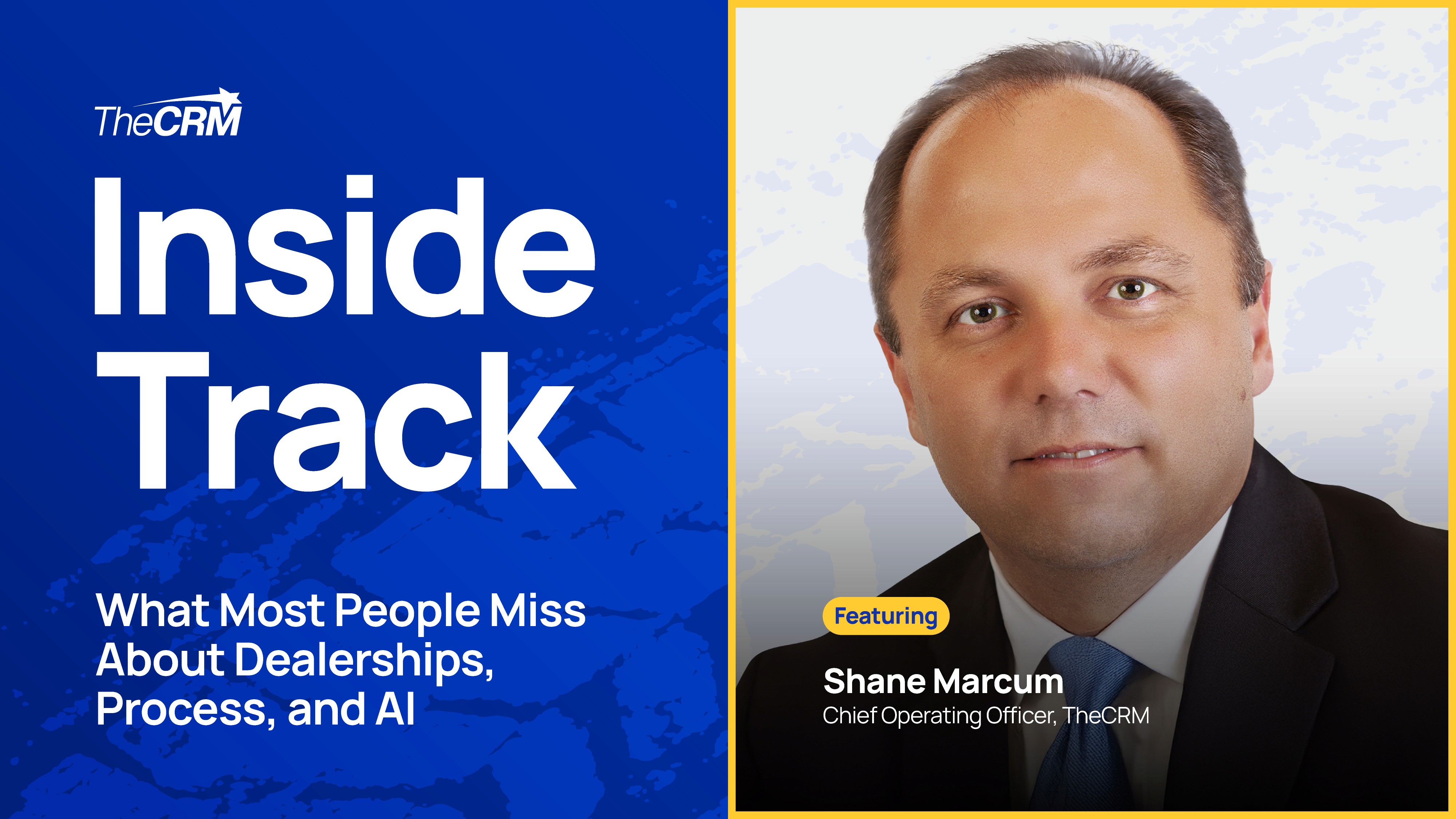
Inside Track: What Most People Miss About Dealerships,
Process, and AI
By TheCRM
January 27, 2026
————————————————————
A conversation with Shane Marcum,
COO of TheCRM
Having spent decades working closely with auto and RV dealerships, Shane Marcum has seen firsthand how misunderstood the industry can be from the outside. In this conversation, he reflects on what surprises newcomers most, why process and culture are inseparable, and how AI fits into dealership operations without replacing the people who make the business work.
The Hidden Complexity of Dealerships
Inside Track:
You’ve spent a long time close to dealerships. What’s something people getting into the industry consistently misunderstand about auto or RV dealerships that only becomes clear once you’re really
in it?
Shane:
The first thing people underestimate is the complexity of the business itself. Almost everyone who enters this industry has bought a vehicle at some point, so they come in thinking, “How hard can this be?” You wait for someone to show up, sell them a car, and move on.
What they quickly realize is that selling vehicles is far more complex than it appears, and it’s only gotten harder over time. Post-COVID, the way customers buy cars changed dramatically. The experience became much more remote during the pandemic, and a lot of that shift has stuck.
RV dealerships add another layer. RVs aren’t necessities in the same way cars are. They’re discretionary purchases, more about lifestyle and recreation. That changes the buyer profile, the sales cycle, and the expectations on both sides. While auto and RV dealerships look similar on the surface, the demographics and buying psychology can be very different, which adds to the overall complexity.
When Operations Break, What’s Really Going On
Inside Track:
When dealerships run into operational issues and things go sideways, what do
you usually find is the real issue beneath
the surface?
Shane:
Every business is vulnerable to process breakdowns. Sometimes there’s a gap in
the process that’s existed for a long time
but never fully surfaced. It quietly creates disruption, and the dealer may not even realize it’s there.
More often, though, processes break because of adoption issues. Either people don’t fully buy into the process, or there’s passive resistance to change. I’ve lived this myself as a dealer. Any time you introduce a new process, it’s uncomfortable. People are used to the old way, even if it isn’t working.
You’ll see pushback, sometimes openly, sometimes quietly. That quiet resistance is the most dangerous because it causes the process to crumble from the inside. If management isn’t actively reinforcing why the process exists and monitoring how it’s being used, weaknesses develop quickly.
A lot of problems also come down to knowledge gaps versus performance gaps. Knowledge gaps can be fixed with training. Performance gaps require visibility into where the process is breaking. Often, introducing a new process or system exposes weak links that were previously hidden. That’s uncomfortable, but it’s necessary.
Culture, Process, and the Role
of AI
Inside Track:
Process is closely tied to culture. How do you see AI affecting culture and the adoption of new processes?
Shane:
Every business has a culture, and every business is vulnerable to a bad one. That ultimately falls on management. AI itself
isn’t vulnerable to culture, but the people using it are.
What’s different about AI-driven process is that it demands adherence. When AI is built into the process, like it is in our CRM, it creates structure that’s harder to ignore. Unlike traditional logic-based software, AI can surface gaps that are often driven by poor habits or bad culture.
As long as users aren’t sabotaging the system and are actually using it as
intended, AI creates transparency. It shows where sales are falling short, where gross profit is leaking, and where operational inefficiencies live. That level of visibility
can be uncomfortable, but it’s also
incredibly powerful.
Adoption, Trust, and Misconceptions About AI
Inside Track:
Do you still see hesitation from dealers around AI? Is it something they’re wary of,
or are they excited by it?
Shane:
There are always adoption issues with new technology. I’ve seen this for more than 25 years as the internet and software reshaped the industry. AI is no different.
There’s often a trust barrier, and sometimes unrealistic expectations. Some dealers think AI can replace their entire team. It can’t. What it can do is reduce workload, improve efficiency, and allow people to focus on higher-value tasks.
AI is a tool. It has to be managed. It has to work alongside the team, not instead of it. Someone still needs to monitor it, guide it, and be available when it hands off a lead
or opportunity. When businesses understand that AI is there to enhance human output, not eliminate it, adoption becomes much smoother.
Learning the Hard Way: Listening to the Customer
Inside Track:
Are there learning moments in your career that really shaped how you approach your role today?
Shane:
There are too many to count. The moment someone stops learning is the moment they start getting stale.
One of the biggest lessons I’ve learned is the importance of listening to the customer. I’ve seen companies thrive when leadership is open to ideas coming from the field. I’ve also seen companies struggle when they ignore the voice of the customer in favor of rigid product roadmaps.
Attrition is a harsh teacher. When customers leave, they’re telling you something isn’t working. The companies that flourish are the ones willing to listen, adjust, and iterate. The idea that “the customer is always right” still matters. We’re here to serve them, but also to help them adopt innovation in a way that actually works for their business.
Advice for Anyone Entering the Industry
Inside Track:
For someone new to working with dealerships, what should they pay attention to that most people miss?
Shane:
You have to learn to speak the dealer’s language. And more importantly, you have to understand their needs well enough to speak that language naturally.
Dealers can spot canned pitches immediately. If you walk in with rehearsed talking points and don’t truly understand how their operation works, you lose credibility fast. Learning dealer terminology, workflows, and how they think about their business brings legitimacy to the conversation. That understanding has to come before product knowledge or competitive positioning.
What Really Matters in Running a Tech Company
Inside Track:
How has being so close to product, sales, marketing, and customers changed how you think about running a
technology company?
Shane:
When I joined TheCRM, it became clear that our operational processes had to scale as fast as our sales. You can sell all the product in the world, but if you can’t deploy it, support it, and train people effectively, growth breaks down quickly.
In a SaaS business like ours, support and relationship management are critical. As you grow customers, those teams have to scale just ahead of demand, not behind it. That balance is one of the most overlooked skills in business management.
It’s easy to be understaffed. It’s easy to be overstaffed. The challenge is staying slightly ahead of growth without losing efficiency or morale. I’ve had to reorganize teams, break existing processes, and upset the status quo to remove bottlenecks. It’s uncomfortable work, but it’s necessary if you want a company to scale responsibly.
At the end of the day, growing a technology company isn’t just about revenue. It’s about making sure your people, processes, and capacity can grow with it.
————————————————————
Inside Track is TheCRM’s insider guide to the evolving world of dealership operations, AI, and sales. Our goal is to learn alongside the industry and share what we’re seeing in real time.
Stay Up-to-Date
with Inside Track
Inside Track: What Most People Miss About Dealerships,
Process, and AI
By TheCRM
January 27, 2026
———————————————————————————————————————————————————————————————
A conversation with Shane Marcum, COO of TheCRM
Having spent decades working closely with auto and RV dealerships, Shane Marcum has seen firsthand how misunderstood the industry can be from the outside. In this conversation, he reflects on what surprises newcomers most, why process and culture are inseparable, and how AI fits into dealership operations without replacing the people who make the business work.
The Hidden Complexity of Dealerships
Inside Track:
You’ve spent a long time close to dealerships. What’s something people getting into the industry consistently misunderstand about auto or RV dealerships that only becomes clear once you’re really in it?
Shane:
The first thing people underestimate is the complexity of the business itself. Almost everyone who enters this industry has bought a vehicle at some point, so they come in thinking, “How hard can this be?” You wait for someone to show up, sell them a car, and move on.
What they quickly realize is that selling vehicles is far more complex than it appears, and it’s only gotten harder over time. Post-COVID,
the way customers buy cars changed dramatically. The experience became much more remote during the pandemic, and a lot of that shift has stuck.
RV dealerships add another layer. RVs aren’t necessities in the same way cars are. They’re discretionary purchases, more about lifestyle and recreation. That changes the buyer profile, the sales cycle, and the expectations on both sides. While auto and RV dealerships look similar on the surface, the demographics and buying psychology can be very different, which adds to the overall complexity.
When Operations Break, What’s Really Going On
Inside Track:
When dealerships run into operational issues and things go sideways, what do you usually find is the real issue beneath the surface?
Shane:
Every business is vulnerable to process breakdowns. Sometimes there’s a gap in the process that’s existed for a long time but never fully surfaced. It quietly creates disruption, and the dealer may not even realize it’s there.
More often, though, processes break because of adoption issues. Either people don’t fully buy into the process, or there’s passive resistance to change. I’ve lived this myself as a dealer. Any time you introduce a new process, it’s uncomfortable. People are used to the old way, even if it isn’t working.
You’ll see pushback, sometimes openly, sometimes quietly. That quiet resistance is the most dangerous because it causes the process to crumble from the inside. If management isn’t actively reinforcing why the process exists and monitoring how it’s being used, weaknesses develop quickly.
A lot of problems also come down to knowledge gaps versus performance gaps. Knowledge gaps can be fixed with training. Performance gaps require visibility into where the process is breaking. Often, introducing a new process or system exposes weak links that were previously hidden. That’s uncomfortable, but it’s necessary.
Culture, Process, and the Role of AI
Inside Track:
Process is closely tied to culture. How do you see AI affecting culture and the adoption of new processes?
Shane:
Every business has a culture, and every business is vulnerable to a bad one. That ultimately falls on management. AI itself isn’t vulnerable to culture, but the people using it are.
What’s different about AI-driven process is that it demands adherence. When AI is built into the process, like it is in our CRM, it creates structure that’s harder to ignore. Unlike traditional logic-based software, AI can surface gaps that are often driven by poor habits or
bad culture.
As long as users aren’t sabotaging the system and are actually using it as intended, AI creates transparency. It shows where sales are falling short, where gross profit is leaking, and where operational inefficiencies live. That level of visibility can be uncomfortable, but it’s also incredibly powerful.
Adoption, Trust, and Misconceptions About AI
Inside Track:
Do you still see hesitation from dealers around AI? Is it something they’re wary of, or are they excited by it?
Shane:
There are always adoption issues with new technology. I’ve seen this for more than 25 years as the internet and software reshaped the industry. AI is no different.
There’s often a trust barrier, and sometimes unrealistic expectations. Some dealers think AI can replace their entire team. It can’t. What it can do is reduce workload, improve efficiency, and allow people to focus on higher-value tasks.
AI is a tool. It has to be managed. It has to work alongside the team, not instead of it. Someone still needs to monitor it, guide it, and be available when it hands off a lead or opportunity. When businesses understand that AI is there to enhance human output, not eliminate it, adoption becomes much smoother.
Learning the Hard Way: Listening to the Customer
Inside Track:
Are there learning moments in your career that really shaped how you approach your role today?
Shane:
There are too many to count. The moment someone stops learning is the moment they start getting stale.
One of the biggest lessons I’ve learned is the importance of listening to the customer. I’ve seen companies thrive when leadership is
open to ideas coming from the field. I’ve also seen companies struggle when they ignore the voice of the customer in favor of rigid product roadmaps.
Attrition is a harsh teacher. When customers leave, they’re telling you something isn’t working. The companies that flourish are the ones willing to listen, adjust, and iterate. The idea that “the customer is always right” still matters. We’re here to serve them, but also to help them adopt innovation in a way that actually works for their business.
Advice for Anyone Entering the Industry
Inside Track:
For someone new to working with dealerships, what should they pay attention to that most people miss?
Shane:
You have to learn to speak the dealer’s language. And more importantly, you have to understand their needs well enough to speak that language naturally.
Dealers can spot canned pitches immediately. If you walk in with rehearsed talking points and don’t truly understand how their operation works, you lose credibility fast. Learning dealer terminology, workflows, and how they think about their business brings legitimacy to the conversation. That understanding has to come before product knowledge or competitive positioning.
What Really Matters in Running a Tech Company
Inside Track:
How has being so close to product, sales, marketing, and customers changed how you think about running a
technology company?
Shane:
When I joined TheCRM, it became clear that our operational processes had to scale as fast as our sales. You can sell all the product in the world, but if you can’t deploy it, support it, and train people effectively, growth breaks down quickly.
In a SaaS business like ours, support and relationship management are critical. As you grow customers, those teams have to scale just ahead of demand, not behind it. That balance is one of the most overlooked skills in business management.
It’s easy to be understaffed. It’s easy to be overstaffed. The challenge is staying slightly ahead of growth without losing efficiency or morale. I’ve had to reorganize teams, break existing processes, and upset the status quo to remove bottlenecks. It’s uncomfortable work, but it’s necessary if you want a company to scale responsibly.
At the end of the day, growing a technology company isn’t just about revenue. It’s about making sure your people, processes, and capacity can grow with it.
———————————————————————————————————————————————————————————————
Inside Track is TheCRM’s insider guide to the evolving world of dealership operations, AI, and sales. Our goal is to learn alongside the industry and share what we’re seeing in real time.
Inside Track: What Most People Miss About Dealerships, Process, and AI
By TheCRM
January 27, 2026
———————————————————————————————————————————
A conversation with Shane Marcum, COO of TheCRM
Having spent decades working closely with auto and RV dealerships, Shane Marcum has seen firsthand how misunderstood the industry can be from the outside. In this conversation, he reflects on what surprises newcomers most, why process and culture are inseparable,
and how AI fits into dealership operations without replacing the people who make the business work.
The Hidden Complexity of Dealerships
Inside Track:
You’ve spent a long time close to dealerships. What’s something people getting into the industry consistently misunderstand about auto or RV dealerships that only becomes clear once you’re really in it?
Shane:
The first thing people underestimate is the complexity of the business itself. Almost everyone who enters this industry has bought a vehicle at some point, so they come in thinking, “How hard can this be?” You wait for someone to show up, sell them a car, and move on.
What they quickly realize is that selling vehicles is far more complex than it appears, and it’s only gotten harder over time. Post-COVID,
the way customers buy cars changed dramatically. The experience became much more remote during the pandemic, and a lot of that shift has stuck.
RV dealerships add another layer. RVs aren’t necessities in the same way cars are. They’re discretionary purchases, more about lifestyle and recreation. That changes the buyer profile, the sales cycle, and the expectations on both sides. While auto and RV dealerships look similar on the surface, the demographics and buying psychology can be very different, which adds to the overall complexity.
When Operations Break, What’s Really Going On
Inside Track:
When dealerships run into operational issues and things go sideways, what do you usually find is the real issue beneath the surface?
Shane:
Every business is vulnerable to process breakdowns. Sometimes there’s a gap in the process that’s existed for a long time but never fully surfaced. It quietly creates disruption, and the dealer may not even realize it’s there.
More often, though, processes break because of adoption issues. Either people don’t fully buy into the process, or there’s passive resistance to change. I’ve lived this myself as a dealer. Any time you introduce a new process, it’s uncomfortable. People are used to the old way, even if it isn’t working.
You’ll see pushback, sometimes openly, sometimes quietly. That quiet resistance is the most dangerous because it causes the process to crumble from the inside. If management isn’t actively reinforcing why the process exists and monitoring how it’s being used, weaknesses develop quickly.
A lot of problems also come down to knowledge gaps versus performance gaps. Knowledge gaps can be fixed with training. Performance gaps require visibility into where the process is breaking. Often, introducing a new process or system exposes weak links that were previously hidden. That’s uncomfortable, but it’s necessary.
Culture, Process, and the Role of AI
Inside Track:
Process is closely tied to culture. How do you see AI affecting culture and the adoption of new processes?
Shane:
Every business has a culture, and every business is vulnerable to a bad one. That ultimately falls on management. AI itself isn’t vulnerable to culture, but the people using it are.
What’s different about AI-driven process is that it demands adherence. When AI is built into the process, like it is in our CRM, it creates structure that’s harder to ignore. Unlike traditional logic-based software, AI can surface gaps that are often driven by poor habits or
bad culture.
As long as users aren’t sabotaging the system and are actually using it as intended, AI creates transparency. It shows where sales are falling short, where gross profit is leaking, and where operational inefficiencies live. That level of visibility can be uncomfortable, but it’s also incredibly powerful.
Adoption, Trust, and Misconceptions About AI
Inside Track:
Do you still see hesitation from dealers around AI? Is it something they’re wary of, or are they excited by it?
Shane:
There are always adoption issues with new technology. I’ve seen this for more than 25 years as the internet and software reshaped the industry. AI is no different.
There’s often a trust barrier, and sometimes unrealistic expectations. Some dealers think AI can replace their entire team. It can’t. What it can do is reduce workload, improve efficiency, and allow people to focus on higher-value tasks.
AI is a tool. It has to be managed. It has to work alongside the team, not instead of it. Someone still needs to monitor it, guide it, and be available when it hands off a lead or opportunity. When businesses understand that AI is there to enhance human output, not eliminate it, adoption becomes much smoother.
Learning the Hard Way: Listening to the Customer
Inside Track:
Are there learning moments in your career that really shaped how you approach your
role today?
Shane:
There are too many to count. The moment someone stops learning is the moment they start getting stale.
One of the biggest lessons I’ve learned is the importance of listening to the customer. I’ve seen companies thrive when leadership is
open to ideas coming from the field. I’ve also seen companies struggle when they ignore the voice of the customer in favor of rigid product roadmaps.
Attrition is a harsh teacher. When customers leave, they’re telling you something isn’t working. The companies that flourish are the ones willing to listen, adjust, and iterate. The idea that “the customer is always right” still matters. We’re here to serve them, but also to help them adopt innovation in a way that actually works for their business.
Advice for Anyone Entering the Industry
Inside Track:
For someone new to working with dealerships, what should they pay attention to that most people miss?
Shane:
You have to learn to speak the dealer’s language. And more importantly, you have to understand their needs well enough to speak that language naturally.
Dealers can spot canned pitches immediately. If you walk in with rehearsed talking points
and don’t truly understand how their operation works, you lose credibility fast. Learning dealer terminology, workflows, and how they think about their business brings legitimacy
to the conversation. That understanding has to come before product knowledge or competitive positioning.
What Really Matters in Running a Tech Company
Inside Track:
How has being so close to product, sales, marketing, and customers changed how you think about running a
technology company?
Shane:
When I joined TheCRM, it became clear that our operational processes had to scale as fast as our sales. You can sell all the product in the world, but if you can’t deploy it, support it, and train people effectively, growth breaks down quickly.
In a SaaS business like ours, support and relationship management are critical. As you grow customers, those teams have to scale just ahead of demand, not behind it. That balance is one of the most overlooked skills in business management.
It’s easy to be understaffed. It’s easy to be overstaffed. The challenge is staying slightly ahead of growth without losing efficiency or morale. I’ve had to reorganize teams, break existing processes, and upset the status quo to remove bottlenecks. It’s uncomfortable work, but it’s necessary if you want a company to scale responsibly.
At the end of the day, growing a technology company isn’t just about revenue. It’s about making sure your people, processes, and capacity can grow with it.
———————————————————————————————————————————
Inside Track is TheCRM’s insider guide to the evolving world of dealership operations,
AI, and sales. Our goal is to learn alongside the industry and share what we’re seeing in real time.